


Employee vs. Independent Contractor: IRS Rules Every Employer Should Know (2026)
Date Released
17 July, 2026
Few payroll decisions carry more financial risk than how you classify the people who do work for your business. Call someone a “contractor” when the IRS would call them an “employee,” and you could be looking at back taxes, penalties, interest, and, in serious cases, personal liability for the owners who signed off on it.
Worker classification questions come up constantly in 2026 as more businesses lean on freelancers, gig workers, and project-based talent alongside their W-2 staff. Although the core IRS classification framework remains based on long-standing common-law principles, worker classification continues to create significant federal and state compliance risks for employers.
This guide walks through exactly how the IRS decides whether someone is an employee or an independent contractor, what W-2 versus 1099 status actually means for your payroll obligations, and how to build a classification process that holds up if the IRS ever comes asking.
What Is the Difference Between an Employee and an Independent Contractor?
At the most basic level, the distinction comes down to control. An employee generally works under the direction of the business: the employer decides how, when, and where the work gets done, and in return, the employer withholds taxes, may provide benefits, and takes on legal responsibilities under labor law. An independent contractor, by contrast, runs their own business, sets their own methods and schedule, and is responsible for their own taxes.
The label on a contract doesn't decide the outcome. The IRS looks at how the working relationship actually functions day to day, and it consistently applies its own test to make that determination.
How the IRS Classifies Workers: The Common Law Test
The IRS relies on what's known as the common law test to determine whether a worker is an employee or an independent contractor. Rather than a single yes-or-no question, the test weighs evidence across three categories, and no one factor decides the case on its own.
1. Behavioral Control
This category asks whether the business directs or controls how the work gets done. Relevant evidence includes the type and amount of instructions given (what tools to use, what order to follow, what hours to keep), whether the worker receives training from the business, and whether an evaluation system measures how the work is performed rather than just the final result. Heavy instruction and oversight point toward employee status; broad autonomy over methods points toward contractor status.
2. Financial Control
Financial control looks at who bears the economic risk and reward. Key questions include whether the worker has made a significant investment in their own equipment or facilities, whether they can realize a profit or a loss based on their own management decisions, whether they're free to seek out other clients at the same time, and how they're paid a flat fee or invoice per project suggests contractor status, while a regular hourly or salaried wage suggests employee status.
3. Type of Relationship
The final category examines how both parties understand the relationship. This includes whether there's a written contractor agreement (helpful, but not decisive on its own), whether the worker receives employee-type benefits such as insurance, paid time off, or retirement contributions, whether the relationship is ongoing versus tied to a defined project, and whether the work performed is a core part of the business's regular operations.
Employers should weigh all three categories together rather than relying on any single factor. A signed independent contractor agreement, for example, will not protect a business if the actual working relationship looks like employment in practice.
If, after weighing these factors, the classification still isn't clear, either the business or the worker can file Form SS-8 with the IRS to request an official determination. This process can take several months, so most employers are better served by building a documented classification review into onboarding rather than waiting on an SS-8 ruling.
W-2 vs. 1099: What Actually Changes in Payroll
Once a worker's status is determined, the paperwork and payroll obligations that follow are very different. Here's how W-2 employees and 1099 contractors compare:
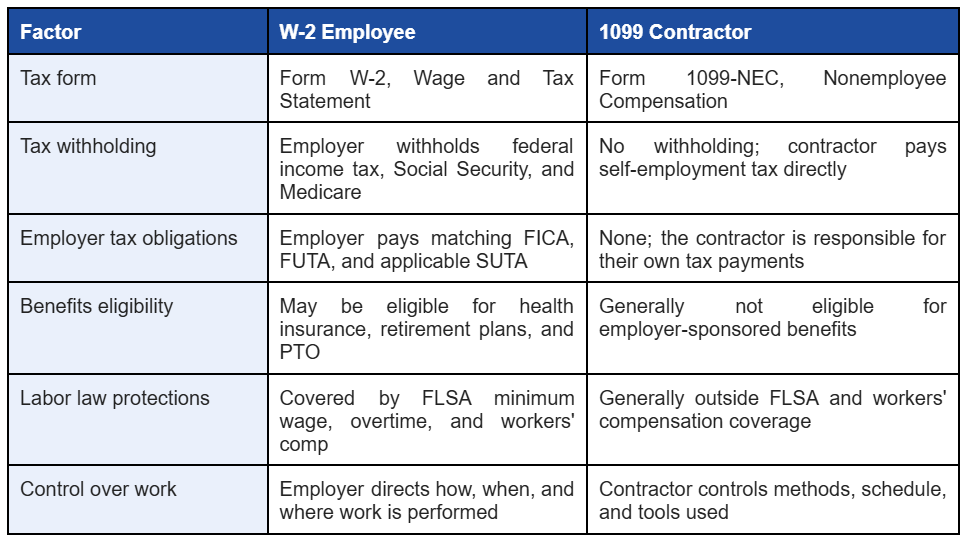
It's also worth knowing that a small group of workers fall into a special category called statutory employees, certain drivers, full-time life insurance agents, and home-based workers, for example, who may be treated as independent contractors under the common law test but are still subject to employment tax withholding under IRS rules. If your workforce includes any of these roles, it's worth a closer look with your payroll provider or tax advisor.
What Happens If an Employer Misclassifies a Worker?
Misclassification is one of the most expensive payroll mistakes an employer can make, and the IRS has made worker classification a recurring audit focus. When the IRS reclassifies a contractor as an employee, it typically looks back three years of unpaid employment taxes or six years if it believes the misclassification was willful.
The tax exposure is calculated under Internal Revenue Code Section 3509, and the rate depends heavily on whether the error was unintentional and whether required 1099-NEC forms were actually filed:
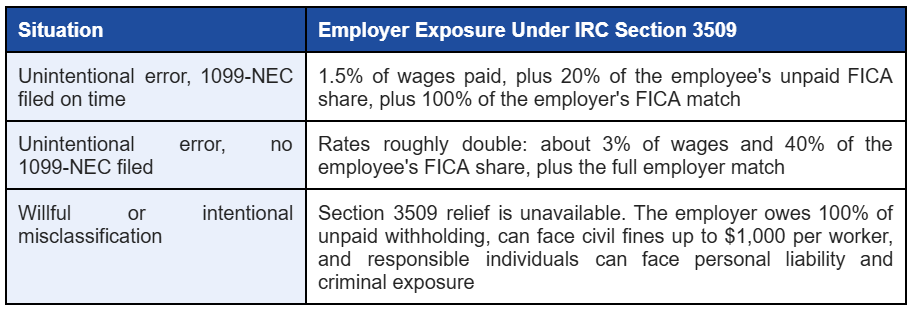
On top of federal exposure, the Department of Labor can pursue separate claims for unpaid overtime and back wages under the Fair Labor Standards Act, and many states apply their own, often stricter, classification tests. Several states use an “ABC test” that presumes a worker is an employee unless the business can prove all three prongs of independence, separate business, and separate trade. State-level penalties for unemployment insurance and workers' compensation violations stack on top of federal ones.
Relief Options If You Discover a Classification Problem
- Section 530 Safe Harbor protects employers from retroactive employment tax liability if contractor treatment was applied consistently and all required 1099s were filed.
- Voluntary Classification Settlement Program (VCSP): lets eligible employers reclassify workers going forward and pay roughly 10% of one year's reduced Section 3509 liability, with no interest or penalties, by filing Form 8952 at least 120 days before the change takes effect.
- Section 3509(a) relief: available only when 1099s were filed on time and the error was not willful. Another reason accurate, on-time 1099 filing matters even when a classification later turns out to be wrong.
Stay Compliant with Confidence
Worker classification rules aren't going away, and the penalties for getting it wrong only grow the longer a misclassification goes unnoticed. The safest approach is building classification review into your standard hiring and payroll process, not treating it as an afterthought.
PayProNext helps growing businesses manage payroll, tax withholding, and worker classification in one place with built-in compliance checks, automated 1099-NEC and W-2 filing, and support from payroll specialists who understand IRS and state-level rules.
Talk to PayPronext today to get a free payroll compliance review and see how much time and risk you can take off your plate.
Frequently Asked Questions
What is the difference between an employee and an independent contractor?
An employee works under the business's direction and control, with taxes withheld and potential access to benefits and labor law protections. An independent contractor runs their own business, controls how the work gets done, and handles their own taxes.
How does the IRS classify workers?
The IRS uses a common law test that weighs behavioral control, financial control, and the type of relationship between the worker and the business. All three categories are considered together; no single factor is decisive.
What happens if an employer misclassifies a worker?
The employer can owe back employment taxes, penalties, and interest under IRC Section 3509, potentially going back three to six years. Willful misclassification removes reduced-penalty protections and can add per-worker fines and personal liability for those responsible for payroll.
Should I issue a W-2 or a 1099?
Issue Form 1099-NEC when a qualifying independent contractor receives at least $2,000 in reportable payments during 2026. A form may still be required below that amount when federal income tax was withheld under the backup-withholding rules.
Can the same worker be both an employee and an independent contractor?
Generally not for the same type of work at the same business. However, a worker could be a W-2 employee for one role and separately provide genuinely independent services to the same company in a distinct capacity if the two engagements are clearly separate and each independently meets the relevant test.
What payroll taxes apply to employees vs. contractors?
Employers withhold federal income tax, Social Security, and Medicare from employee wages and pay a matching FICA share plus federal and state unemployment tax. Contractors receive gross pay with no withholding and are responsible for paying self-employment tax directly to the IRS.
How can employers stay compliant with IRS classification rules?
Document the basis for every classification decision at the time of hire, apply the common law test consistently, file 1099-NECs on time, revisit classifications when a role changes, and use payroll software or a payroll compliance partner that flags classification risk before it becomes a filing problem.